

A Guide to Tracked Spider Lifts for Narrow Spaces
Key Takeaways:
Tracked spider lifts are the best elevated access solution for narrow jobsites. Their compact design, tracked mobility and stability systems allow operators to work worry-free in challenging environments such as:
- Tight workspaces
- Uneven grounds
- Sensitive surfaces
These platforms manage to strike the perfect balance between access, control, and adaptability.
Whether you are in construction, tree care, or infrastructure maintenance, you must have heard of tracked spider lifts. These modern marvels of engineering offer exceptional reach and stability in places where cranes struggle to offer both.
But what makes them so special? And why are they the perfect choice for narrow spaces?
In today’s blog, Platform Basket Canada – suppliers of the best spider lifts in Ontario, will attempt to answer all of your questions in our comprehensive guide to these tracked machines! Let’s begin.
What Is a Tracked Spider Lift and Where Is It Used?
Knowing what tracked spider lifts are is the first step to understanding what they do and why they are the best elevated access solution out there for narrow spaces.
What is a tracked spider lift?
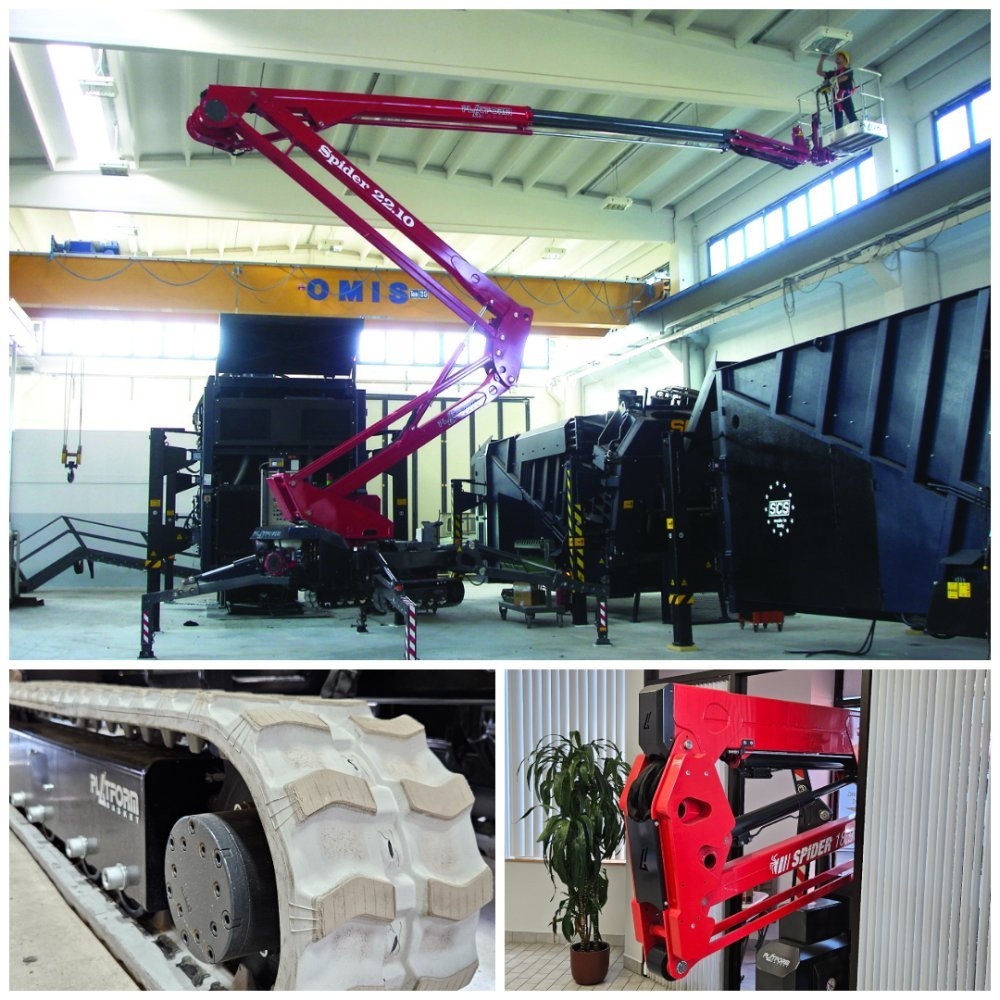
A tracked spider lift is a type of compact aerial lift platform that features a crawler-style undercarriage instead of wheels to allow better traction and mobility on a wide variety of surfaces. This design also supports even distribution of the machine’s weight across the operating surface, thus preventing sensitive grounds from suffering damage.
What makes this machine different from traditional boom lifts or scissor lifts is its ability to access and operate safely on restricted or unpredictable terrain. Capable of folding neatly into itself for easy mobility, it also makes them a good choice for indoor projects where space is severely limited.
Why are tracked spider lifts used for narrow access job sites
Limited entry points are typical of narrow workplaces. This can make it a challenge to work safely at heights, thus requiring the use of specialized equipment. Tracked spider lifts are specialized equipment.
In their folded state, they can fit through anything – from standard doorways to freight elevators. They can easily navigate tight pathways and confined areas, allowing workers to position them precisely for elevated work. This fusion of mobility and stability that they bring is what makes them the right fit for constrained environments.
Indoor vs outdoor narrow access applications
The use of these machines need not be restricted to outdoor work. They can be safely used to carry out elevated tasks in atriums, warehouses, commercial buildings, and residential units – basically anywhere that requires floor protection and quieter operations.
Indoor vs outdoor narrow access applications
These machines support elevated work in construction and renovation, arboriculture and tree care, facility maintenance, and industrial inspection and repair.
Common Job Site Challenges in Narrow Access Areas
Any site with restricted access is, by default, difficult to work with. It can make elevated areas that much more inaccessible. However, that is not the only challenge that plagues these job sites. Others include:
Limited entry points and tight pathways
Most job sites that involve renovation or repair work in dense urban localities have narrow entry gates, doorways, or corridors. That means only equipment that is compact enough to fit through them can be used. Anything larger or difficult to maneuver is automatically eliminated.
Uneven ground and sensitive flooring
It might sound strange, but narrow access is typically characteristic of spaces with uneven ground or sensitive surfaces. Both types of grounds cannot handle heavy loads that well and require the use of machines that are lightweight by design. They are the ones that can safely operate on landscaped areas, tiled floors, and unfinished surfaces.
Obstacles and overhead structures
What do walls, ceilings, beams, balconies, and utility lines have in common? Each of them is capable of obstructing machine movement and positioning – especially when its boom is in an extended position. Working around such obstacles demands precise control and planning.
Working safely at height in confined areas
Aerial work platforms that offer stability and controlled movement are necessary to work safely at heights in tight spaces, as they do not offer much margin of error to work with. Even the smallest movements have to be perfectly angled to prevent damage or accidents.
Checklist: Narrow Access Job Site Challenges
Here is a quick recap of everything that makes it difficult to work at height in spaces with narrow access:
- Tight entry points and doorways
- Limited space to set up and operate platforms
- Unpredictable terrain with slopes or unevenness
- Fragile flooring indoors
- Presence of overhead or surrounding obstacles
- Limited turning radius and navigation space
Why Tracked Spider Lifts Work Best for Narrow Access Job Sites
Tracked spider lifts have no match as far as working in narrow access jobsites is concerned. Not only is their crawler-style undercarriage a major advantage in such environments, but their form-factor is highly beneficial too. Let us explain:
Compact design and narrow width
In their folded state, spider lifts are no more than 35 inches wide. That is extremely narrow. In fact, most standard doorways have a width of about 36-38 inches, which means they are actually wide enough for spider lifts to fit through without any hassle or damage.
Track system for uneven terrain
The functionality of wheels on uneven ground is quite limited. But that is not the case with crawler undercarriages. They can easily move on all kinds of grounds – whether it is made of gravel, tiles, or even soft soil.
Outriggers for stability in tight spaces
Most high-quality spider lifts feature sturdy outriggers, which, when deployed, create a stable base for the entire machine. This allows operators and workers to carry out elevated tasks with minimal risk and more peace of mind.
Lightweight design for indoor use
When compared with traditional cranes that are known for their exceptional bulk, aerial lifts are rather lightweight, so they can be used indoors or on landscaped surfaces without causing damage.
Better maneuverability than traditional lifts
Precise movement is one of the strongest USPs of these machines. This makes it easier to position them in tight spaces where movement is an issue.
Each of these advantages makes tracked spider lifts the top choice for challenging Canadian jobsites, including those with restricted access and uneven terrain.
How to Navigate Narrow Spaces with a Tracked Spider Lift
By now, we have established these mean machines as the undisputed champs of difficult jobsites. But they are only effective when they are used correctly. Before taking them onsite, operators must understand safe spider lift operation to work incident-free in narrow spaces.
Step 1: Assess access width and ground conditions
This is an essential part of the spider lift operation planning process. A thorough evaluation of the site, including its entry points and ground conditions, will support the smooth deployment of the platform once it arrives on-site.
Step 2: Choose the right lift size and width
These machines come in varying heights and lifting capacities, which can influence their overall size. Operators must choose the right-sized lift to ensure it meets the access and height requirements of the site concerned.
Step 3: Plan entry and exit path
During ground evaluations, operators must map the entire journey of the lift, including its entry, exit, twists, slopes, and obstacles on the path to curtail the risk of tip-overs and accidents.
Step 4: Set up outriggers safely
If outriggers are to be deployed, operators must make sure the equipment is positioned on stable ground before doing so. The machine’s built-in self-leveling systems can be used for the same purpose.
Step 5: Operate the lift with proper controls
Sudden movements should be avoided at all costs as they can cause severe harm or damage. If the lift has to be repositioned, the movement should be highly controlled and precise.
Step 6: Follow safety procedures during operation
Operators should be aware of their surroundings at all times. They should be particularly mindful of any obstacles or overhead structures and should take proper precautionary measures to ensure safe operation.
Steps Recap: Operating in Tight Spaces
Here is a handy list of steps required for safe spider lift operation in tight spaces:
- Measure the width of the access point before equipment delivery
- Evaluate ground conditions
- Take note of overhead obstacles, if any
- Position the lift precisely and deploy outriggers once it’s on stable ground
- Keep the machine level at all times
- Test its controls before extending its boom
- Maintain slow and controlled operations in tight areas
- Retract the boom before each movement
Choosing the Right Tracked Spider Lift for Narrow Access Work
Most operators wonder about the correct way to choose the most suitable tracked spider lift for narrow access work. There is a simple formula for that, and it involves matching platform type with the job’s specific requirements, which include:
Working height
Determining the height needed for the job, including both vertical and horizontal reach, can help contractors make the right choice.
Machine width and access limitations
The chosen lift must be able to fit through the narrowest access point available on-site for it to qualify as an optimal choice.
Power source: electric vs diesel vs hybrid
Depending on the job location, operators can choose between electric, diesel, and hybrid lifts. For example, electric lifts are the quietest of the lot, which makes them ideal for indoor operations. On the other hand, diesel options are the more power-efficient option for remote jobsites. Hybrid models can be used in environments that demand flexible indoor/outdoor operations.
Indoor vs outdoor usage
Spider lifts used for indoor operations must be compact and lightweight enough to safely work on fragile floors. Outdoor conditions typically do not require such careful consideration.
Transport and setup requirements
Larger platforms need additional space for staging and movement. Meanwhile, compact versions might be cheaper to transport and require less space to function when delivered onsite.
Checklist: How to Choose the Right Lift
Here is a spider lift selection checklist operators can refer to whenever they need help in selecting the most appropriate model:
- Assess the required working height
- Select models that fit the narrowest onsite access point
- Evaluate ground conditions against available models
- Choose appropriate lifts for indoor and outdoor use
- Factor in power requirements and weight restrictions
- Account for outreach requirements
- Match safety features as per project requirements
Safety Tips for Using Tracked Spider Lifts in Tight Work Areas
It might seem as if the odds of accidents are lower in narrow worksites due to a lack of space, but they are actually more accident-prone. Even a small wrong movement can cause serious damage to both the property and the operator. Hence, following the safety tips given below is critical:
Ensure proper set-up
The lift should be completely stable before operation and elevation begins. Improper setup is the leading factor behind accidents.
Load capacity and stability
As a general rule, the machine’s load capacity should never be exceeded. It can affect the way it distributes weight, causing it to lose its balance.
Working around obstacles
During operation, operators must make sure there is a safe distance between the platform and any surrounding walls, structures, or overhead hazards.
Operator training and certification
Only trained operators should be allowed to use spider lifts. Untrained individuals will not have the same level of skill required to work with the controls of the machine and maintain safety protocol.
Emergency procedures
Every spider lift model comes with emergency controls that the operator must familiarize themselves with so they know how to act in unexpected situations.
Safety Checklist:
- Inspect the lift carefully for issues before every use
- Deploy outriggers only when the machine is on stable ground
- Never exceed the platform’s load capacity
- Maintain a safe distance from all onsite obstacles
- Use appropriate safety gear on the job
- Follow the machine manufacturer’s guidelines for safe operation
Conclusion: Why Tracked Spider Lifts Are Ideal for Narrow Access Job Sites
Tracked spider lifts are the perfect elevated access solution for narrow access job sites due to their portability, precise positioning, lightweight form-factor, and tracked undercarriage. Adaptable and stable, they offer reliable performance and safety in challenging conditions.
Platform Basket Canada offers dependable and compact spider lifts tailor-made for Canadian work environments. Contact us to explore our range of capable and stable machines.
FAQs
What is a tracked spider lift used for?
Tracked spider lifts are primarily used for elevated work in a wide variety of industries, including construction, maintenance, and tree care.
Can a spider lift fit through a standard doorway?
Yes. Spider lifts in their folded format can easily pass through doorways with the standard width of 36 to 38 inches.
Are tracked spider lifts safe for indoor use?
Yes. Tracked spider lifts with electric engines are well-suited for indoor work due to their compact frame and quiet operation.
What is the difference between a spider lift and a scissor lift?
The major difference between a spider lift and a scissor lift lies in their design and their reach capabilities. Scissor lifts offer vertical access only, while spider lifts can extend both vertically and horizontally.
Is proper training required to operate a spider lift?
Yes. Operators must have a legally valid license that certifies they are qualified for the safe and efficient use of spider lifts.