

How Arborists Evaluate Spider Lifts for Tree Work
Key Takeaways:
While the features of a spider lift might seem like the core criteria why arborists select certain models, their final choice is actually based on:
- Ground conditions
- Access constraints
- Reach requirements
- Job objectives
This blog breaks down why spider lifts are chosen for certain types of arboriculture tasks and swapped for others.
While trees might seem easy to work with, the environments they are in are never quite predictable. As a professional arborist in Ontario, you already know that your jobsite is going to be wildly different from tree to tree, property to property, and season to season.
The icing on this complexity cake? Ground conditions, access points, and surrounding obstacles. Each is a variable and can largely influence how work is done. More than the tree itself does.
In such cases, your choice of access equipment cannot be restricted to the features of a machine alone. What a machine can do is nearly not as important as whether it can actually work efficiently and safely on a particular jobsite without causing any damage. That is the real million-dollar question.
While the features of spider lifts might make them popular, the equipment or model you ultimately end up with will directly affect safety, access, productivity, and liability on any jobsite.
Don’t know where to begin? In today’s blog, Platform Basket Canada – Ontario arborists’ favorite spider lift manufacturer- will show you how to evaluate working conditions and access options so you can make the right choice.
Understanding The Realities Of Arborist Jobsites
In theory, all tree care sites might seem largely similar – especially when segregated into urban or suburban environments- but the reality is different. Each site is unique in its own ways, with the following facets acting as variables:
Ground conditions around root zones
A tree’s root systems can create uneven ground conditions, depending on its location. While trees in urban centers may have concrete surrounding them, making for a stable surface, those in backyards and rural areas often have soft soil and a layered landscape. Your choice of equipment should be such that it does not cause any damage to the soil or the tree’s root structure.
Slopes, uneven terrains, and limited access points
It is common for tree worksites to be uneven, sloped, or partially inaccessible, especially in areas such as backyards, embankments, ravines, and parklands. They can limit your machine’s staging area and restrict access routes, thus requiring equipment that can safely pass over turf, pavers, or driveways.
Working near structures, utilities, and obstacles
From fences to powerlines, homes and sheds – most tree work will take place in close proximity to any of these structures. That is why the equipment you choose should offer flexible and lightweight positioning. This prevents encroachment and the creation of new hazards.
Residential vs commercial tree work constraints
For residential jobs, you must choose an access solution that is built for minimum disruption and maximum property protection. As for commercial projects, machines that prioritize efficiency, repeatability, and public safety should take precedence.
Spider lifts are operable in most of the above conditions as long as you match your job’s requirements and site conditions to their capabilities.
Core Criteria Arborists Use To Evaluate Spider Lifts
Though spider lifts might have become the default choice for tree care, you should still evaluate them against your site’s specific conditions to know whether they are actually suitable for the job.
Ground pressure and impact on turf and roots
One of the first things you need to evaluate is exactly how much ground pressure the lift exerts. If the applied pressure exceeds the surface’s tolerance limits, damage to turf, compact soil, and root systems is likely. This single criteria plays a huge role in the feasibility of spider lifts as an option.
Stability on slopes and soft surfaces
Sloping grounds with soft soil can pose stability issues for even the most solid access equipment. So before you narrow down on a spider lift, make sure it remains stable on uneven ground, even in an extended state.
Vertical and horizontal reach requirements
While access solutions that reach exceptional heights are great, your choice of equipment should also provide dependable horizontal reach, as tree canopies tend to span far and wide. Basically, the machine should allow you to access different sections of the canopy without the need for excessive repositioning so you can avoid assuming risky angles.
Basket positioning relative to canopy spread
Tasks like pruning and controlled removal of branches and sections of trees require precise basket positioning. Make sure the aerial lift you choose lets you work as close to the cut zone as possible without compromising safety or stability.
Setup footprint and maneuverability
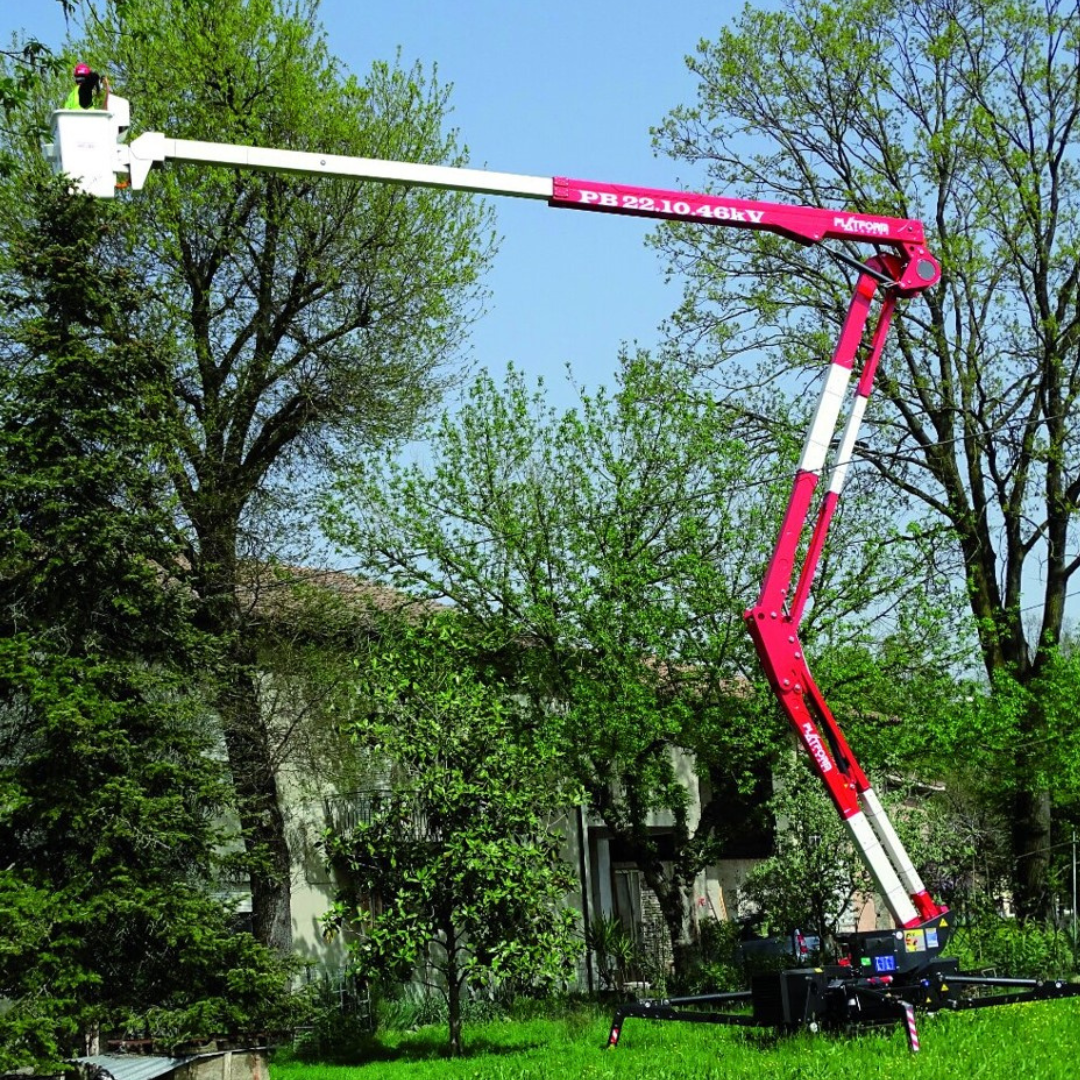
Space constraints are a given on most arboriculture sites. However, you can tackle them safely with the help of a compact spider lift that features proper outriggers along with a footprint that can easily fit through gates, side yards or the space between two structures.
Initial Spider Lift Evaluation Questions
Before you rent or purchase a spider lift for your tree care operations, make sure you ask the vendor or the manufacturer the following questions to get the right platform:
- Can the lift tackle ground disturbances?
- Can it access the work area without causing damage?
- Can it safely reach the desired horizontal and vertical distances?
- Will it be able to handle low clearance zones for setup?
- Can it be repositioned efficiently without compromising its stability?
When Spider Lifts Are Evaluated As The Right Fit
When it comes to certain tree care tasks, nothing compares to the capabilities spider lifts offer. Their compact and lightweight structure can effortlessly handle the following work conditions:
Tight residential properties
Residential properties often feature narrow access paths, limited driveway spaces or landscaped yards – all of which require the use of a compact, self-leveling lightweight machine that does not damage the surface it comes in contact with. That is where spider lifts excel.
Urban and municipal tree maintenance
Municipal tree care crews have no choice but to work in constricted urban spaces with active footfall, thus requiring the use of a machine that minimizes disruptions – just like spider lifts do with their compact form factor.
Jobs requiring minimal ground impact
Turfs and work zones classified as sensitive need access methods that keep surface damage to a minimum. Spider lifts are undisputed champs in this regard.
Precision pruning and controlled removals
Spider lifts offer the kind of precise positioning pruning work needs. They tend to remain stable even as you go about tending to wide canopies.
There is a reason why spider lifts in arboriculture are highly favored by professionals. Their compactness, along with their lightweight construction, ensures access is smooth and damage-free even in the most challenging spaces.
Situations Where Arborists Reconsider Using Spider Lifts
So far, we have made arguments for using spider lifts in tree care. Now let’s talk about situations where they might not be the best access option available to you.
Extremely soft or saturated ground
Wet ground is slippery and highly unstable. It can hinder the safe deployment of aerial lifts. So if using this machine is more dangerous than safe, avoid it.
Dense undergrowth and limited access paths
If you have been assigned to work in a heavily wooded area, consider using a machine that is capable of working in spots with no clear access routes. Spider lifts need the latter to function optimally.
Large-scale removals requiring heavy lifting
Removing huge trunks requires specialized equipment. Think heavy rigging. Using low-capacity spider lifts models can actually be ill-advised here due to the risk of tip-overs. It is better to look at alternatives such as cranes, which are designed to handle exceptionally heavy loads.
Time-sensitive jobs with frequent repositioning
Constant movement is not the forte of most spider lifts. If your job demands frequent repositioning around a tree or trees, you might be better off using other methods, such as ladders, for example. Not the safest means, but easy to reposition.
Red Flags To Watch Out For
Before you choose a spider lift for tree care, take these red flags into account:
- Excessively unstable ground
- Inadequate width for access
- Higher canopies beyond the safe reach limits of aerial lifts
- Frequent repositioning
- Availability of more suitable alternatives
Comparing Spider Lifts To Other Arborist Access Methods
To truly know if spider lifts are the best option for the tree care tasks, you should stack them up against their leading alternatives and evaluate the results. Options to consider include:
Spider Lifts vs. Climbing
Whether you use a harness to climb a tree or a ladder, there are pros and cons to this choice. A harness might be safer, but it takes a lot of time to set up. Ladders have minimal set-up time and are easy to reposition, but are highly unsafe. On the other hand, spider lifts maximize safety and minimize worker risk and fatigue.
Spider Lifts vs. Bucket Trucks
While setting up bucket trucks is fast and easy, they are not the most suitable choice for environments with sensitive grounds and narrow access. So if the latter conditions are critical for your project, you may as well choose spider lifts.
Spider Lifts vs. Cranes
The lifting capacity of cranes is unmatched. However, it often comes at a higher cost along with greater setup complexity and logistical coordination. If your project doesn’t have the budget for it, a spider crane might be a good middle ground.
Why Arborists Should Assess Trade-Offs, Not Just Advantages
Before you settle upon a choice, you need to know that no single option is universally superior. Each machine and access method brings its own advantages for tree care. They carry their own cons too. That’s why your final choice should be entirely based on trade-offs most relevant to the task at hand.
How Arborists Align Spider Lift Selection With Tree Care Objectives
Ultimately, the core objectives of your tree care task should take precedence over any other factor in access equipment selection. Here’s how you can align common tasks with the right machine:
Precision pruning vs. full removals
If the former is your aim, you cannot go wrong with a spider lift. However, if the latter is your goal, a crane might be the most suitable choice as it can lift the weight of large trees without losing its stability.
Risk management and crew safety
Tree care environments can get unpredictable depending on the season, ground conditions and the height at which you need to work. Spider lifts can be instrumental in reducing fall risk, worker fatigue, and unpredictable movement.
Protecting the surrounding property
Skip larger machines if you are working on sensitive grounds. The best way to avoid collateral damage to landscaping, structures, and surfaces is to use a spider lift.
Minimizing jobsite disruption
Certain settings, such as residential areas or local municipalities, require the use of equipment that emits low noise, provides compact access, and is capable of working for longer durations. No points for guessing which machine does that.
You cannot go wrong with spider lifts for tree care in most situations. They are a safe choice with impressive reach and stability.
Evaluation Is Not Optimization – Why Process Comes First
There is one last step to making sure you have the right tree care equipment with you on the job, and that requires evaluating the following:
Prioritize safety
Instead of focusing on the fastest machine, prioritize onsite suitability and safety.
Avoid equipment-driven decision-making
You don’t want to choose equipment solely on its availability. You want to choose equipment that actually fits the job.
Match tools to the job, not habits
Any complementary tools you use for tree care tasks should also sync with the job at hand rather than your personal preferences. This is a simple way to avoid overloading whichever machine you choose.
Conclusion – How Arborists Make Confident Spider Lift Decisions
Conducting a sharp assessment of ground conditions and aligning it with the capability of available spider lift models is the only way to make a confident choice.
Want to instill extra confidence in your choice? Pick a reliable manufacturer. Platform Basket Canada is the most trusted supplier of spider lifts that Ontario arborists prefer. Contact us to explore our range of compact and lightweight machines.
FAQs
Are spider lifts suitable for all types of tree work?
No. To determine the viability of a spider lift for tree care tasks, you must assess ground conditions, access, and job scope first.
How do arborists decide between climbing and lifts?
The choice between climbing and using a lift for tree care depends on factors such as safety, efficiency, and positioning requirements.
Do spider lifts damage tree roots or turf?
They can if the ground pressure is not properly evaluated before spider lift deployment. That is why a thorough assessment is critical.
What type of terrain limits the use of spider lifts?
Soft, saturated, or inaccessible grounds may pose a hindrance to the safe and effective deployment of spider lifts.
Are spider lifts commonly used by professional arborists in Canada?
Yes. Especially in residential, municipal, and urban localities, spider lifts are excellent in minimizing disruptions, emissions, and noise pollution.