

Electric Boom Lift Selection Guide for Industrial and Commercial Projects
Key Takeaways:
Quiet, eco-friendly, and perfect for emission-sensitive zones, electric boom lifts are widely used in industrial and commercial work across Ontario. However, choosing the right model among them requires careful research with special emphasis on the machine’s:
- Reach
- Capacity
- Terrain
- Battery requirements
- Configuration
- Access restrictions
Each of these should be evaluated against the demands of the job to ensure a perfect fit.
Synonymous with “safe elevated access”, aerial lifts have been the mainstay on industrial and commercial worksites for decades now. In fact, their electric versions have been widely preferred over their diesel counterparts for their quiet, low-emission operations.
Powered by rechargeable batteries as opposed to a combustion engine, electric boom lifts virtually produce zero exhaust emissions during operations. Moreover, every single one of their functions runs on battery, whether it’s their drive system, boom extension, or platform controls.
Their core components include a dedicated battery pack along with electric motors, boom assemblies, hydraulic or electric systems, and safety devices, which allow them to work safely in indoor conditions. No wonder contractors frequently use them for warehouse operations, indoor construction, installations, maintenance, and other similar indoor projects.
However, while contractors can choose between articulating and telescopic models, the problem arises in determining which electric boom lift is actually right for their project. That is something experts from Platform Basket Canada, Ontario’s top manufacturer of advanced aerial lifts, can help you with.
Go through our detailed selection guide to find the perfect electric boom lift match for your project.
Why Choose an Electric Boom Lift?
There are plenty of reasons to choose an electric boom lift for industrial and commercial projects, irrespective of whether they take place indoors or outdoors. Major reasons why battery-powered platforms should be a serious contender for your next project include:
Zero-emission operation
First and foremost, battery-powered boom lifts produce zero emissions. That means they can be safely used in all kinds of emission-sensitive zones. Think indoor environments, ecological reserves, historical infrastructure, enclosed manufacturing facilities, etc. Basically anywhere that prioritizes preserving local air quality.
Low-noise performance for indoor environments
Electric motors are significantly quieter when compared with diesel engines. So for example, if a specific type of elevated work is scheduled to take place in noise-sensitive environments such as schools or hospitals, electric lifts become the default choice.
Improved maneuverability in confined spaces
The compact dimensions and responsive drive systems of electric boom lifts are another one of their major benefits. These machines can maneuver around tight spots, thereby serving as smart alternatives to traditional cranes.
Lower operating and maintenance costs
Oil changes are expensive. Not to mention, servicing diesel engine systems and exhausts can increase maintenance costs. In comparison, electric lifts offer low-cost maintenance, which keeps their operational expenses in check over the entire course of their lifecycle.
Enhanced workplace safety
With emissions and noise levels under control, electric boom lifts create a more comfortable working environment for everybody present onsite. They also incorporate essential safety features such as auto-shutdowns and emergency controls, which make them a safer choice overall.
Factors to Consider When Selecting an Electric Boom Lift
As essential and safe as they may be, not all battery-powered aerial work platforms will prove to be the right choice for a specific project. Since they are available in various configurations, operators must exercise caution before selecting a particular model. Factors that support electric aerial lift selection include:
Required working height and outreach
Each project comes with its own height and outreach requirement. The right lift should be able to cover both the vertical and horizontal distances required to work safely onsite. Prioritizing one or the other is not recommended as the resultant machine might prove to be inadequate for the project concerned.
Platform capacity requirements
Different aerial lift models come with different weight limits; ignoring which can be catastrophic. So instead of risking it with a lower capacity model, factor in the combined weight of workers, tools, equipment, and other materials into your selection criteria. That ensures the final model offers sufficient capacity for the task.
Indoor vs. outdoor applications
Boom lifts for indoor work should feature compact dimensions and a lightweight build to easily access constricted work areas without damaging delicate flooring. As for outdoor projects, larger machines can be used. However, they should come with self-leveling systems, feature a weather-resistant build, and be able to adapt to changing ground conditions.
Ground conditions and terrain
The ground conditions of finished projects are bound to be different from those of projects still under construction. Similarly, the presence of slopes, surfaces, obstacles, access routes, and uneven ground conditions can affect equipment selection.
Battery performance and charging requirements
Battery capacities of each configuration can be different. Ideally, the runtime of the chosen model should match the expected work cycle of a project. In any case, your final selection will also largely depend on the infrastructure of your worksite and whether it offers access to acceptable charging outlets.
Articulating vs. telescopic boom configuration
If your project requires a machine that can work over and around obstacles, go for an articulating boom lift. However, if reaching long horizontal distances is the top priority for your project, a telescopic boom lift will be the better choice.
Transportation and storage considerations
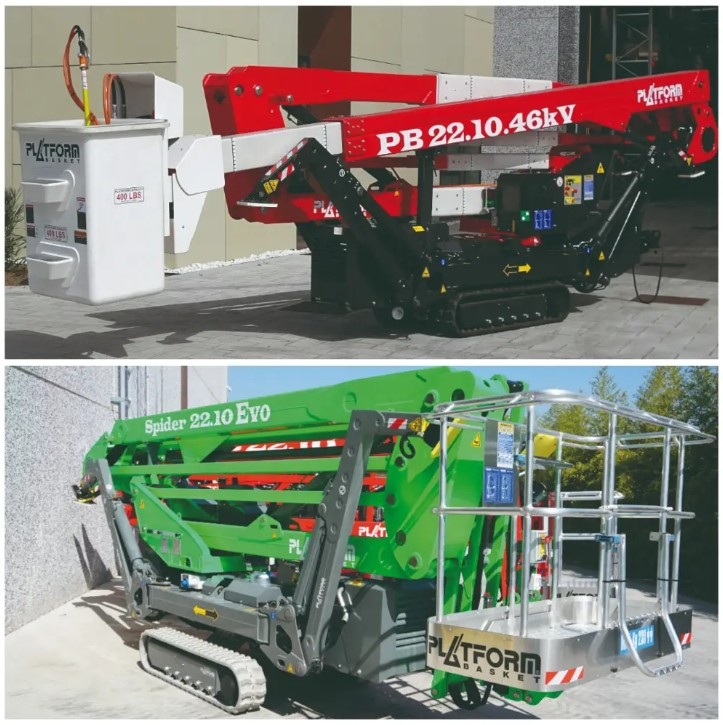
Compact equipment is easier to move and store due to its ability to fit through standard doorways and freight elevators. In fact, Platform Basket Canada’s spider lift models fold neatly for storage, solving complex access challenges without any hassle.
Matching Electric Boom Lifts to Different Applications
Syncing electric boom lift selection with their respective applications is a wise approach. Of course, each environment brings its own working conditions, so verifying selected models against them ensures a truly perfect match.
Warehouse and distribution centers
Compact electric spider lifts are the way to go for warehouses and distribution centers. Their lightweight build and stellar reach capabilities can simplify a range of tasks including the installation and maintenance of lighting systems, overhead sprinkler systems, HVAC equipment, and much more.
Manufacturing facilities
Low-emission aerial lifts can help manufacturing plants achieve their sustainability goals while ensuring the successful completion of several critical tasks. These include machinery maintenance, electrical installations, overhead repairs, and more. They truly contribute to the creation of safe enclosed working spaces.
Commercial building maintenance
Electric atrium lifts are ideal for building maintenance purposes. From shopping centers and offices to hotels and other types of commercial properties, electric lifts enable safe lighting and signage installations, HVAC repairs, facade maintenance, and other tasks that demand quiet maneuverability.
Data centers and utility installations
Data centers have strict rules regarding the use of elevated access equipment. Only compact and lightweight electric platforms can be used here. They should be able to work their way around sensitive infrastructure without causing damage or introducing exhaust fumes in enclosed technical spaces.
Airports and public infrastructure
Regular maintenance activities are part of airports and other large public facilities. Electric boom lifts allow safe elevated access in such spaces as normal operations continue in the background. Their minimally invasive designs make them a great choice for busy areas.
Common Mistakes When Choosing an Electric Boom Lift
Even the selection of electric boom lifts is not free of a couple of common mistakes. Fortunately, avoiding them is entirely possible. All you have to do is keep the following in mind to fool-proof the entire process:
Selecting insufficient working height
Choosing a lift that exceeds your project’s working height is better than opting for one that undercuts it. Basing your decision on the lift’s actual requirements ensures workers can safely access elevated work zones.
Ignoring platform load requirements
Failure to account for the complete workload of your project can increase the risk of machine tip-overs. Make sure you calculate the weight of additional personnel, tools, and equipment before choosing a lift for its rated weight capacity.
Overlooking battery runtime
A mismatch between planned work cycle and the machine’s battery runtime can lead to expensive downtime on time-sensitive projects, so be sure to verify the equipment’s runtime.
Choosing the wrong boom configuration
Using an articulating boom lift on a project that requires a telescopic boom lift or vice versa can severely impact a project’s productivity and performance.
Failing to evaluate job site conditions
Ignoring critical factors such as uneven terrain, floor conditions, slopes, access routes, overhead obstacles, or environmental conditions can lead to the deployment of an unsuitable lift, creating a real risk of workplace accidents, injuries, and damages.
Step-by-Step Electric Boom Lift Selection Process
Follow the steps given below to ensure you get the right electric boom lift each time, no matter the requirements of your job:
Step 1: Define the work environment
Determine the primary working area of your project, i.e., whether it is indoors, outdoors or a mix of the two.
Step 2: Measure working height and reach
Instead of simply measuring the height of the building, individually measure the highest working point of your project along with its maximum horizontal distance to get the right lift.
Step 3: Assess load requirements
Calculate the combined weight of the operator, working crews, tools, and other equipment and assess the final result against the weight capacity of your chosen model to ensure safe operations.
Step 4: Evaluate site conditions
Review floor surfaces, slopes, access points, access paths, and presence of obstacles to plan selection based on real-world working conditions.
Step 5: Compare available boom configurations
Determine whether an articulating or a telescopic boom lift better matches the geometry and reach requirements of your project.
Step 6: Confirm safety and compliance requirements
Verify if your shortlisted model meets all of the safety and compliance requirements of your project to prevent fines, liabilities, and accidents of any kind. Any operators or crews you hire should be formally trained to use mobile elevating work platforms.
Best Practices for Safe and Efficient Operation
Long-term projects should adhere to the following strategies to ensure safe operations on every shift:
- Daily pre-use inspections: Perform thorough visual inspections before each use to locate signs of damage. Check the machine’s individual systems to ensure they work as expected before deployment.
- Monitoring battery performance: Track your machine’s battery conditions and charge levels to prevent unexpected shutdowns and failures.
- Following manufacturer operating guidelines: Never exceed the machine’s rated reach and weight capacity. Stay within its limitations for safe use.
- Scheduling preventive maintenance: Regular servicing helps in the early detection of possible faults and failures, reducing repair and replacement costs.
Conclusion
The process of choosing the right electric boom lift starts with the individual requirements of your project. Evaluating its reach, access demands, and working conditions and verifying them against the features of a lift guarantees a perfect fit.
Want to improve the access, efficiency, and productivity of your project? Platform Basket Canada provides the most capable CSA-accredited aerial work platforms in Ontario. Contact us to explore our extensive catalog of noise- and emission-sensitive lithium-ion battery-powered options.
FAQs
What is an electric boom lift used for?
An electric boom lift is used to carry out a wide range of installation, maintenance, and repair tasks in environments that demand low noise and zero-emission operations
What is the difference between electric and diesel boom lifts?
Diesel boom lifts are powered by fuel, which makes them suitable for long hours of outdoor work. On the other hand, electric models are powered by batteries, offer a relatively shorter runtime, and are suitable for indoor applications.
Can electric boom lifts be used outdoors?
Yes, they can be if they have been designed specifically for outdoor use, i.e., they should be able to adapt to outdoor terrains, weather, and dynamic working conditions.
How long does an electric boom lift battery last?
Runtime varies depending on a specific model’s battery capacity. In fact, other factors such as workload, terrain, and operating conditions can influence runtime too.
How do I choose the right electric boom lift?
Base your selection on your project’s individual height, reach, weight, terrain, access, and runtime requirements to ensure you get the right fit.