

Types of Aerial Lifts: Which Machine Fits Your Job?
Key Takeaways:
- Aerial lifts come in several types, and each type serves a different access requirement
- Primary categories include scissor lifts, articulating boom lifts, telescopic boom lifts, vertical mast lifts, spider lifts, and truck-mounted platforms.
- Factors such as working height, reach, ground conditions, platform capacity, access restrictions, and site-safety requirements should be considered during equipment selection
The smartest and safest way to work at heights, aerial lifts are favored for their reach, stability, and powerful performance in nearly all kinds of weather and environmental conditions.
However, knowing which aerial lift to choose for different project stages and applications is key to reaping its benefits.
Platform Basket Canada, manufacturers of intelligent Italian-engineered aerial lifts in Ontario, has prepared a guide on different aerial work platform types and their jobs to simplify selection.
What Are Aerial Lifts?
For the uninformed, aerial lifts are mechanical equipment that allow vertical access to workers, tools, and other approved materials for above-ground tasks.
A variety of aerial work platform types are available to operators, including scissor lifts, telescopic and articulating boom lifts, spider lifts, vertical mast lifts, and truck-mounted platforms. Each offers different capabilities and serves different purposes.
How Aerial Lifts Provide Elevated Access
All aerial lift models feature elevated access capabilities. While some rely on hydraulic scissor assemblies, others use booms to raise workers to their required height. Depending on their type, certain lifts may also provide horizontal access.
Aerial Lifts vs. Aerial Work Platforms
Aerial lifts and aerial work platforms are interchangeable terms that refer to the same equipment used for raising workers so they can safely work at heights. However, as mentioned, types vary.
What Are the Main Types of Aerial Lifts?
Aerial lifts can be classified into 6 major types, each offering unique mechanisms and access capabilities. New operators and crews who are unfamiliar with them need to know the following about each so they can compare lift types and choose the best option for their job.
Scissor Lifts
Featuring a folding support mechanism, scissor lifts support the vertical elevation of its platform, which is generally more spacious when compared to other lift types. Their roomy deck makes them ideal for tasks like construction, installation, and maintenance that require raising both tools and workers simultaneously. However, they generally need a firm, level surface to operate.
Articulating Boom Lifts
Articulating boom lifts are known for their signature jointed arms that can be bent to access multiple angles and heights, making them the perfect choice for obstacle-dense work zones. In fact, this type is a common fixture on industrial sites, urban maintenance zones, and any worksite with structural features that prevent direct access.
Telescopic Boom Lifts
Telescopic boom lifts feature extending boom sections that can be used to access both vertical and horizontally located work areas. Their mix of elevated and horizontal outreach makes them perfect for tasks such as structural construction, exterior maintenance, and a wide range of other industrial activities.
Vertical Mast Lifts
Featuring a compact mast, these lifts are designed to raise workers for the purposes of indoor maintenance tasks, warehouse jobs, and more. They are commonly used in narrow aisles for material handling tasks. Since they are rather small in size, they can be safely used in places where larger platforms do not fit.
Spider Lifts
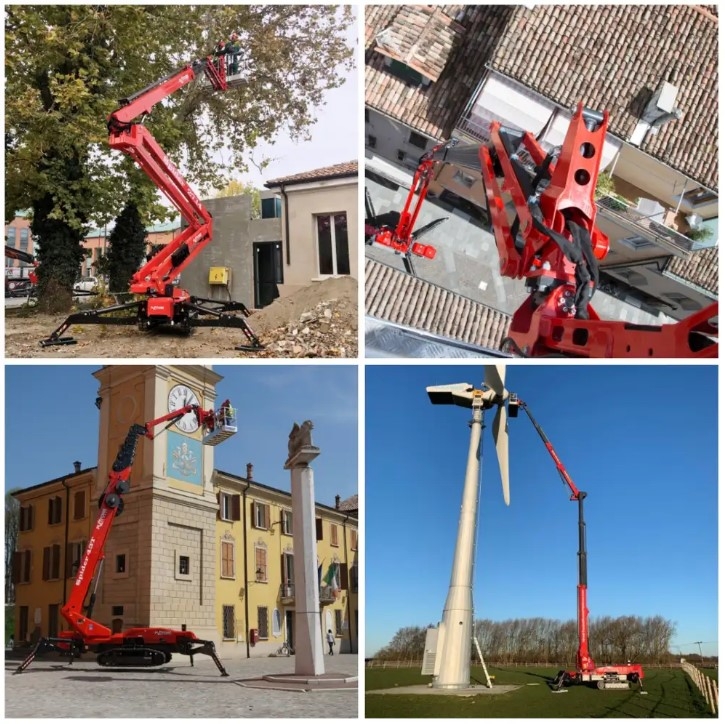
Spider lifts offer a unique combination of a compact form factor, tracked base, stabilizing outriggers, and elevating boom, which makes them truly one of the most versatile types of aerial lifts. Depending on the model operators choose, they can be used either indoors or outdoors and on uneven or sensitive surfaces.
Truck-Mounted Aerial Lifts
Truck-mounted lifts have their platform securely fitted onto a truck, which allows crews to easily travel between various outdoor work locations. They offer extensive reach and powerful lifting capacity, and hence, can be used for utility maintenance tasks, street lighting repairs and installations, telecom maintenance, etc.
Here’s a direct comparison between each aerial work platform type, their capabilities, and applications to help site managers pick the best option for their job:
Lift Type | Main Movement | Typical Applications | Key Consideration |
| Scissor Lift | Vertical | Construction and indoor installation | Requires a suitable setup surface |
| Articulating Boom Lift | Up, over, and around | Industrial and building maintenance | Obstacle clearance |
| Telescopic Boom Lift | Straight outward and upward | Structural and exterior work | Reach and working radius |
| Vertical Mast Lift | Compact vertical movement | Warehouse jobs and indoor maintenance | Limited outreach |
| Spider Lift | Articulating or telescopic boom | Restricted access and specialized work | Outrigger setup and ground conditions |
| Truck-Mounted Aerial Lift | Vehicle-mounted boom movement | Utilities and roadside work | Vehicle access and setup space |
Where Are Different Aerial Lifts Used?
Selecting the right aerial lift depends heavily on a specific task’s requirements and its site conditions. In fact, different jobs bring their own access requirements, and evaluating how a lift fulfils them is a foolproof method of finding the perfect fit.
Construction and Building Maintenance
For overhead installations and interior finishing work, scissor lifts prove to be a viable choice. Meanwhile, boom lifts provide the type of outreach facade and structural work demand. Spider lifts are also commonly used on construction sites with limited access.
Industrial Facilities and Warehouses
If access in narrow aisles is top priority, there is no better equipment than vertical mast lifts. However, for tasks involving work around or near machinery, articulating boom lifts prove to be a better choice. Scissor lifts can be used to complete indoor tasks that demand roomier decks.
Infrastructure and Specialized Access Work
Tasks that require specialized access, such as mobile utility work, can use truck-mounted platforms to get the job done. On the flip side, boom lifts can support detailed infrastructure inspection and maintenance jobs. Operators can explore aerial work platform applications in our guide to understand how they serve different industries.
Tree Care and Other Outdoor Applications
Spider lifts are often the preferred choice for arboriculture. However, boom lifts are a dependable alternative. Before choosing a lift type, operators must evaluate the terrain, canopy access, and specific requirements of their job. Rough-terrain scissor lifts can also be used for other outdoor applications.
Work Requirement | Equipment to Consider |
| Straight vertical indoor access | Scissor or vertical mast lift |
| Reaching over obstacles | Articulating boom lift |
| Long horizontal outreach | Telescopic boom lift |
| Narrow entrance or restricted setup | Spider lift or compact mast lift |
| Multiple roadside locations | Truck-mounted aerial lift |
| Suitable outdoor work on uneven terrain | Spider or rough-terrain lift |
How to Choose the Right Aerial Lift for Your Job
Operators wondering which aerial lift platform would be the best choice for their job can use the following six steps to arrive at a well-informed decision:
Determine the Required Working Height
Workers must evaluate the highest point they need to reach during a specific task to understand which type of lift offers safe access. The task’s actual reach requirements should be compared against the machine’s manufacturer-rated working height and platform height to find the best fit.
Evaluate Horizontal Reach and Obstacles
The distance between the machine and the work area matters, as existing structures such as walls, roof edges, etc. are likely to prevent direct access. In such cases, workers may choose articulating or telescopic boom lifts over others if they meet the rest of their job criteria.
Check Access Width and Setup Space
A site’s permissible clearance is a determining factor for equipment selection. Dimensions of doorways, corridors, and turning areas must be compared against a lift’s measurements for safe access. Site managers can consider a spider lift for tight spaces if access is limited.
Assess Terrain and Ground Conditions
Ground conditions can affect the stability and set-up of all aerial lifts. Hence, factors such as slope, firmness, surface sensitivity, and the ground’s load-bearing capacity should be assessed before machine selection.
Consider Platform Capacity and Work Requirements
Site managers must check if their chosen lift is rated to carry the total weight of workers, tools, and other permitted materials required for a specific task. Overloading is seriously hazardous and can cause fatal accidents. That’s why checking rated platform capacity and other limitations is critical.
Evaluate Mobility and Power Requirements
Job-specific conditions such as indoor vs outdoor use, travel distance, emission restrictions, and charging or refueling access matter during aerial lift selection. Only lifts that meet a project’s power and mobility requirements should be used.
Aerial Lift Safety and Operating Considerations
Safe aerial lift operations hinge on appropriate equipment selection. Once the right machine has been chosen, site managers must ensure the following to preserve on-site safety:
Operator Training and Equipment Familiarity
Only certified, trained professionals who are familiar with the machine’s make, controls, and emergency functions should be allowed to use it.
Site Inspection and Ground Stability
Along with ground conditions, the equipment itself should be inspected before use. This is critical for onsite safety.
Weather, Load Limits, and Safe Operation
Aerial lift safety involves adhering to manufacturer-specified limits for wind and other environmental conditions. Additionally, the machine’s rated capacity and reach limits should never be exceeded, and required clearance should always be maintained during operation.
Conclusion
The best aerial lift matches its job’s height, reach, access, terrain, and capacity requirements. Before selection, site managers must understand the strengths and purposes of each lift and match them accordingly to relevant jobs. As long as the machine is in good condition, it can be safely used on site.
Platform Basket Canada provides the safest aerial lifts in Ontario. Combining extensive reach with exceptional stability, our platforms can be used across a wide range of industries and applications. Contact us to explore our machine catalog or to book a demo.
FAQs
Major types of aerial lifts?
Scissor lifts, articulating boom lifts, telescopic boom lifts, vertical mast lifts, spider lifts, and truck-mounted lifts are the major categories of aerial lifts.
How are boom and scissor lifts different from each other?
A scissor lift features a wide platform and supports vertical movement only, whereas a boom lift features an articulating or telescopic arm that offers horizontal and vertical access.
What is a spider lift used for?
Spider lifts are used for a wide range of applications, including tree care, construction, facade installation and maintenance, indoor work, etc.
Which is the best aerial lift option for indoor jobs?
Due to their compact form factor, scissor lifts and vertical mast lifts can be used indoors. Specific configurations of spider lifts that support indoor operation are a good option too.
How to choose the right aerial lift?
The best way to choose the right platform is to match the job’s height, access, outreach requirements, ground conditions, and load-bearing capacity against the lift’s specifications and features.