

Automatic Levelling In Rail Boom Lifts: Why Its Needed For Curved Tracks
Railway infrastructure is complicated. Maintenance crews have to deal with several challenges including uneven grounds, nighttime operations, and electrified corridors, to name a few. Add curved tracks to the list and it becomes necessary to use specialized maintenance equipment that stays stable and protects workers from accidents when working at heights.
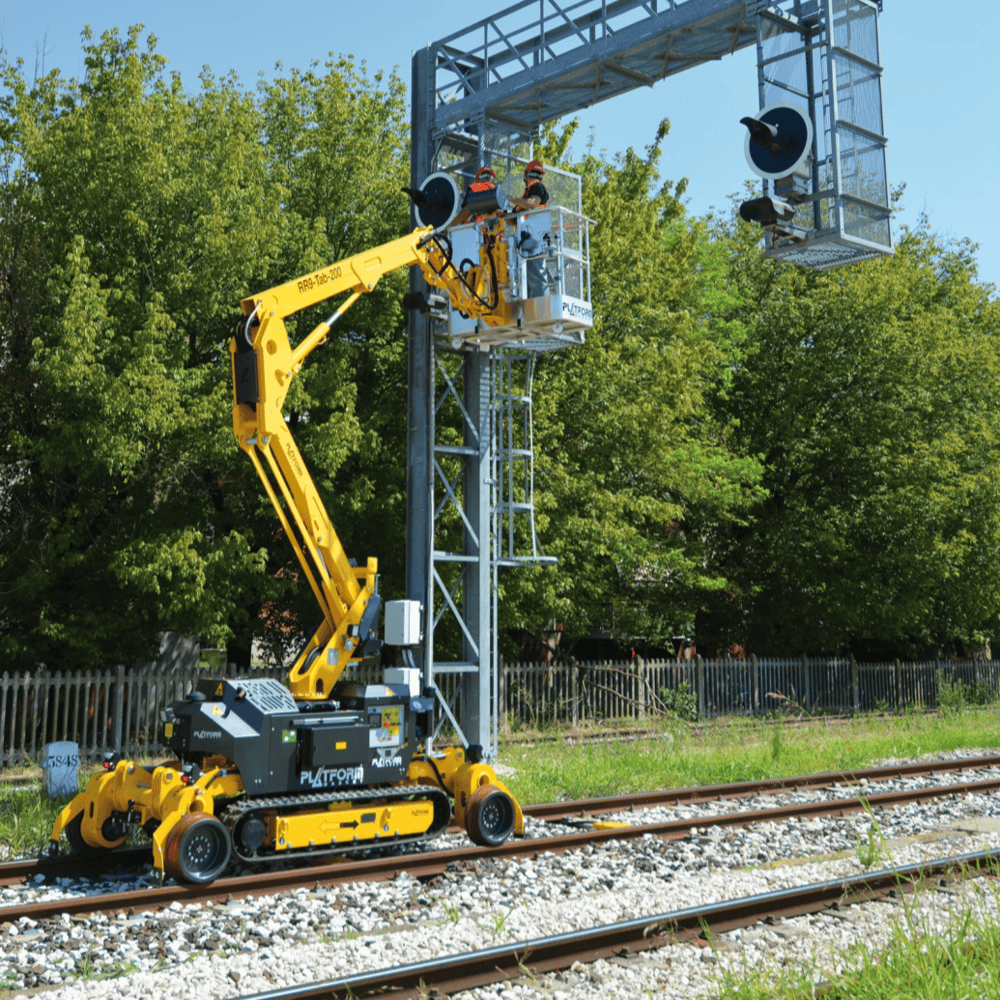
Enter Platform Basket Canada’s rail boom lifts that have been purpose-built to work on Ontario railway tracks. Featuring automatic self-levelling systems, our machines allow crews stable and precise positioning on curved tracks without compromising safety or efficiency.
In today’s blog, we will discuss how their levelling systems work, why they matter, and how they support the unique geometry of railway tracks.
Understanding Track Geometry & Its Impact On Rail Access Equipment
Most railway tracks around the world feature curves, gradients, and cants. Each of these, while designed to support smooth train operations, can be difficult for maintenance crews to work on. Here is how they impact infrastructure tasks.
What is track cant?
Railway tracks tilt intentionally wherever they curve. This particular tilt is referred to as track cant. The outer track on each curve features a slight elevation which helps trains to maintain their balance when they are running at high speeds.
How track cants around curves impact equipment stability
Most vertical access machines need a stable base to work on. Curves with track cants on a railway line create an uneven base, causing most equipment to lean one way or the other when positioned on top of them. This affects the machine’s stability and can make crews nervous about working at heights.
The challenge of working on gradients
Gradients refer to the slope or elevation changes that take place on railway tracks. Alongside curves, these variations can complicate the stable positioning of vertical access equipment.
To overcome these challenges, the use of specialized machinery such as Platform Basket Canada’s self-levelling rail boom lifts is a must.
What Is Automatic Levelling In Rail Boom Lifts?
Our rail boom lifts come with an automatic leveling system built in that can be used to adjust their base so that maintenance crews get a level working platform even if the ground underneath is uneven.
We swapped manual adjustments for self-levelling capabilities to compensate for:
- Track cants
- Uneven railway grounds
- Surface level inconsistencies
The core purpose of this self-levelling system is to keep our machines stable and aligned so that crews can carry out elevated tasks without worrying about the risk of accidents or tip-overs.
Why Automatic Levelling Matters On Curved Tracks?
There are several advantages to having self-levelling systems in aerial boom lifts. We equipped our machines with these systems to ensure:
Platform stability
Safe elevated work requires a level base. Our automatic levelling system ensures the platform retains its balance even when the ground conditions are not favorable.
Greater operator control
Perfectly levelled platforms make it easy for operators to move them precisely without leading to unwanted tilts. That means you can safely position our lift closer to the actually working area, provided no overhead obstacles are blocking access.
Set-up time reduction
Manual levelling systems are not only extremely complex, they take a lot of time to get the balance right. Time is of the essence on railway sites as crews often have to work between train schedules and even a second’s delay can be costly. Automatic systems streamline set-up, enabling faster task completion.
Enhanced worker safety
Rail environments can get unpredictable, requiring continuous equipment adjustment to suit ground condition variations. Our self-levelling aerial boom lifts do that automatically so you do not have to worry about manual readjustments or accidental tipovers every time surface conditions change.
Conclusion
Standard aerial access equipment is not the perfect choice for curved railway tracks. Their cants and gradients complicate navigation and level positioning, requiring the use of specialized equipment. Platform Basket Canada’s rail boom lifts feature self-levelling systems that allow them to stay stable and support efficient maintenance work on Ontario railway lines. Contact us to explore the full range of our rail access equipment.
FAQs
Can standard boom lifts be used on railway tracks?
It is ill-advised to use them on railway tracks as they do not come with in-built safety and stability features that such complex working conditions require.
Do all rail boom lifts feature automatic levelling systems?
No. It depends on the manufacturer if their platforms feature self-levelling systems. All of Platform Basket Canada’s models do.
How do Platform Basket Canada’s rail boom lifts maintain their alignment when switching from road to rail and vice versa?
They rely on their integrated rail guidance systems that lock the platform’s wheels in place to maintain perfect alignment on varying ground conditions.